Cotton vs Microfiber Mops: Which Is Better for Commercial Cleaning?
Floor maintenance represents upwards of 40% of total janitorial labor hours in commercial buildings. Consequently, selecting the correct mopping technology directly impacts custodial productivity, chemical consumption, and hygienic efficacy. For decades, traditional spun cotton string mops served as the industry standard, but engineered microfiber mops have rapidly reshaped institutional floor care across European facilities.
Understanding the Material Science
Cotton is an organic cellulose fiber with naturally hollow strands that excel at absorbing large volumes of liquid. This makes cotton Kentucky mops and socket mops exceptional for large-scale spill recovery and rough, unfinished industrial concrete surfaces. However, cotton fibers merely push greasy soil around on smooth surfaces rather than capturing microscopic particulates.
In contrast, microfiber consists of synthetic polyester and polyamide filaments split to 1/16th the diameter of a human hair. These split fibers create millions of microscopic wedges and capillary channels that mechanically lift and trap dust, grease, and up to 99% of bacteria without requiring heavy chemical detergents.
Hygienic Efficacy and Contamination Control
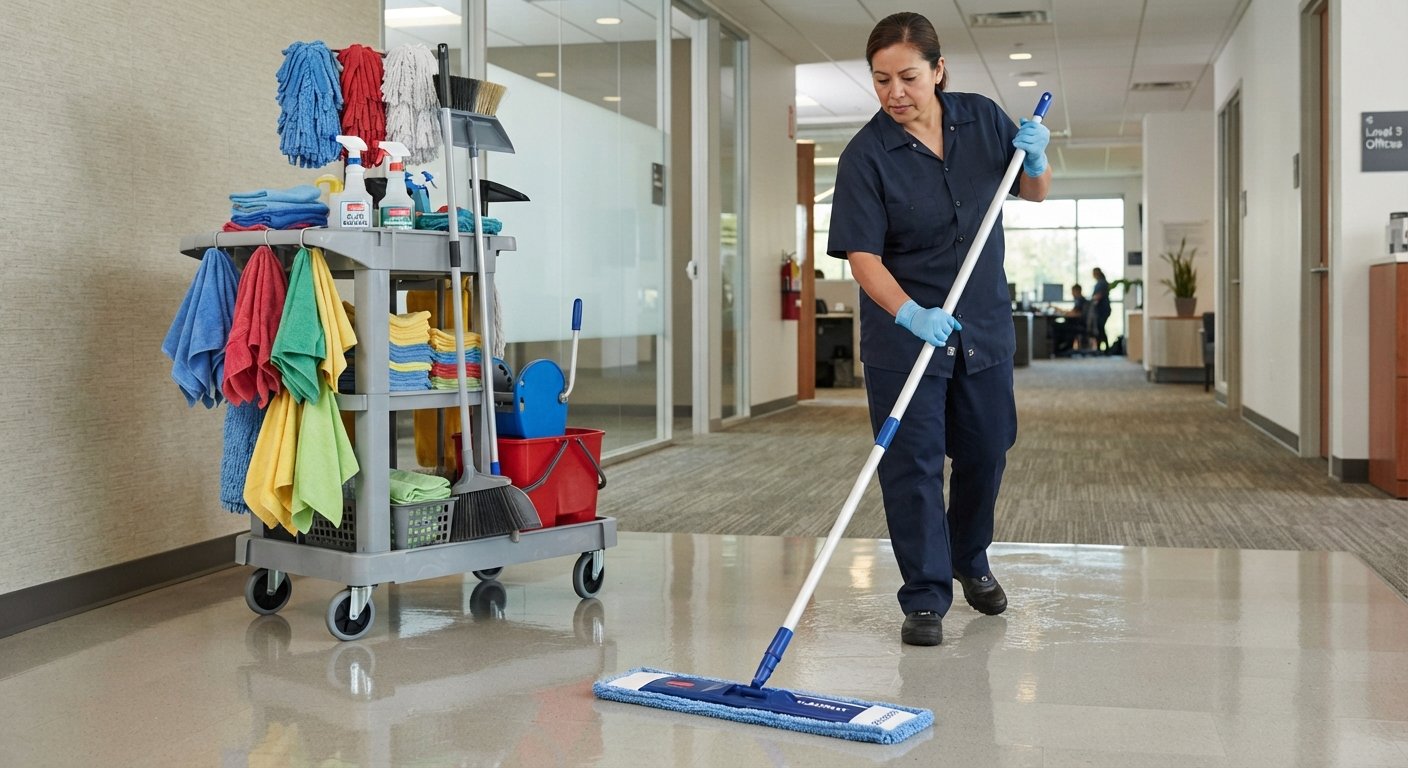
In healthcare, educational, and cleanroom environments, microfiber flat mops hold an indisputable advantage. Microfiber pads are designed for single-room use and quick-change Velcro or pocket mounting, virtually eliminating room-to-room cross-contamination. Cotton string mops, when repeatedly dipped into a single-bucket wash solution, tend to redistribute dirty wastewater across contiguous floor areas.
For high-spec clinical disinfection, facility managers consistently transition to commercial microfiber flat mop systems to achieve verified hygiene compliance.
Laundering Lifespan and Operational Cost of Ownership
While microfiber flat mops carry a higher initial purchase price than simple cotton heads, their total lifecycle cost is dramatically lower:
- Laundering Durability: Premium microfiber mop pads endure 250 to 500 commercial wash cycles, whereas cotton heads begin unraveling and shedding lint after 30 to 50 cycles.
- Chemical & Water Savings: Microfiber requires 70% less water and up to 50% less floor chemical to clean equivalent square meterage.
- Ergonomics & Labor: Microfiber flat mops weigh significantly less than waterlogged cotton mops, reducing repetitive strain injuries (RSI) among cleaning personnel.
Chemical Interaction and Cleaning Speed
Microfiber fibers are non-porous and highly resistant to commercial quaternary ammonium compounds, whereas natural cotton can absorb and neutralize active biocidal ingredients—a phenomenon known in the industry as "quat binding." In facilities requiring rigorous sanitization, using cotton mops can unknowingly reduce the disinfectant's active concentration on the floor, failing sanitary inspections.
Furthermore, because microfiber pads deposit a thin, uniform moisture film rather than saturating the floor, drying times are reduced from twenty minutes down to under three minutes. This rapid dry time drastically mitigates slip-and-fall hazards in high-traffic retail corridors and corporate office lobbies.
The B2B Verdict: Strategic Application Mapping
Choose cotton string mops for rough outdoor walkways, warehouse oil spills, and heavy mechanical fluid cleanups. Choose microfiber flat mops for interior commercial corridors, hospitals, corporate offices, schools, and polished retail flooring.
Operational Protocol: Laundering and Maintenance
Maximizing the return on investment for microfiber mopping hardware requires adherence to proper commercial laundering protocols. Microfiber pads must be laundered at temperatures between 60°C and 70°C using liquid detergents free of bleach and optical brighteners. Never introduce commercial fabric softeners, as cationic surfactants coat the split polyester filaments and permanently eliminate their electrostatic attraction and capillary absorption capacity.
For facilities managing multiple zones, establish a clean pad dispensing station where pre-dosed microfiber heads are stored in sealed tubs, ready for instantaneous deployment by cleaning staff.
Providing authoritative insights on commercial cleaning equipment, B2B procurement, and European hygiene standards since 2020 from IJmuiden, The Netherlands.